
The Mint thread lift is a non-surgical facial lifting procedure that uses MINT PDO threads with molded 3D barbs to reposition sagging tissue in the cheeks, jawline and neck. At Re:berry Hongdae, it is done under local anesthesia in about 30–60 minutes, with swelling typically settling within 1–2 weeks. Results vary by individual.
Re:berry Clinic Hongdae · Information reviewed for accuracy · Results vary by individual.
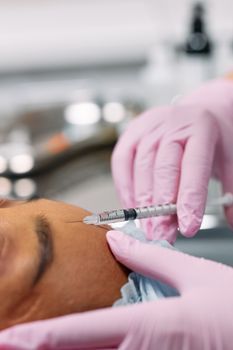
What is a Mint thread lift?
A Mint thread lift is a minimally invasive lifting procedure that places absorbable threads under the skin to lift and hold sagging tissue. MINT is a brand of polydioxanone (PDO) thread whose barbs are molded in three dimensions rather than cut into the thread. This structural design is intended to give the barbs a firmer grip on the tissue while keeping the thread itself strong.
PDO is the same material long used in absorbable surgical sutures. Over several months the threads dissolve, and as they do, the body forms new collagen around them. This means a Mint lift has two effects: an immediate mechanical lift and a slower improvement in firmness.
How is MINT different from other PDO threads?
Many barbed PDO threads have barbs made by cutting into the thread, which can weaken it at each cut. MINT threads are produced with a pressed, molded process, so the barbs are part of a thicker, more robust structure. Clinics often choose MINT where a stronger hold is needed, such as along the jawline or for heavier cheeks.
Re:berry also offers the Dooth thread lift. The choice between them depends on tissue thickness, the direction of lift you need and how much support is required. Our Dooth vs Mint comparison explains the criteria in more detail.
Who is a good candidate for a Mint thread lift?
Mint threads typically suit adults in their 30s to 50s with mild to moderate sagging who want a visible lift without surgery. Good candidates usually have reasonable skin quality and realistic expectations about the degree of change.
- Flattened or descending cheeks and deepening nasolabial folds
- Early jowls and a softening jawline
- Marionette shadows linked to tissue descent
- Mild neck laxity in selected cases
Who may need a different approach?
People with very thin skin, very heavy tissue or significant excess skin may get limited benefit, and surgery or energy-based lifting may be discussed instead. Threads are usually postponed during pregnancy, active skin infection, uncontrolled autoimmune disease or bleeding disorders, and around recent filler in the same plane.
What happens during the procedure?
- Design: the doctor marks the entry points and vectors of lift while you are sitting up, so gravity is taken into account.
- Anesthesia: numbing cream and local anesthetic are applied along the planned paths.
- Insertion: threads are placed through small entry points with a blunt cannula or needle, then gently tensioned to reposition the tissue.
- Finishing: thread ends are trimmed below the skin and the face is checked for symmetry.
The procedure usually takes 30–60 minutes depending on the number of threads. You can typically leave the clinic the same day, though some people prefer to rest at their hotel or apartment for the evening.
What is recovery like after a Mint thread lift?
Expect swelling, tightness and some tenderness, particularly when chewing or yawning, for about 3–7 days. Small bruises may appear at entry points. Mild skin dimpling or pulling sensations often settle as the tissue relaxes over the first one to two weeks.
- Sleep on your back with your head raised for the first few nights.
- Avoid wide mouth opening, facial massage and dental work for about 2–4 weeks.
- Skip saunas, jjimjilbang visits, intense exercise and alcohol for at least a week.
- Follow the clinic's aftercare sheet; see also aftercare after thread lifting.
What are the risks and side effects?
Common, usually temporary effects include swelling, bruising, asymmetry, dimpling and a feeling of tightness. Less common risks include visible or palpable threads, thread extrusion, infection, nerve irritation and prolonged pain. Contact the clinic promptly if you notice increasing pain, redness, warmth or discharge. A doctor's examination before treatment helps reduce risk by matching thread type and placement to your anatomy.
How long does a Mint thread lift last?
PDO threads typically dissolve over about 6–12 months, while the collagen response may help maintain support for around 1–2 years. Longevity varies with age, skin thickness, lifestyle and how much tissue was lifted. Results vary by individual, and some people choose maintenance with energy-based treatments.
Is a Mint thread lift practical for a Seoul trip?
If you are visiting, allow several days in Seoul after the procedure so the doctor can check swelling and thread position if needed. Quieter activities, such as walking along the Gyeongui Line Forest Park or cafe-hopping, are easier than long, active days during the first week.
Can a thread lift be combined with other treatments?
Re:berry prefers to design a combination plan. Threads reposition tissue, while ultrasound devices such as Ultherapy Prime tighten deeper layers, and boosters improve skin quality. These are often staged weeks apart. Volume loss may be addressed with filler, but timing and depth are planned carefully around the threads.
Pricing and booking in Hongdae
Cost depends on the number and type of threads and the areas treated. It is confirmed in writing at consultation, before any procedure. Book via the channels on our Booking page, and check Location & Hours for the branch address and opening hours.
Key facts
- Treatment time: About 30–60 minutes, plus numbing
- Anesthesia: Local anesthesia; no general anesthetic
- Downtime: Swelling or tightness for about 3–7 days; mild bruising possible
- Results seen: Immediate repositioning, with gradual collagen support over 1–3 months
- Lasts: Commonly cited as about 1–2 years, varying by person and area
- Best for: Mild to moderate sagging of the midface, jowls and jawline
Frequently asked questions
Does a Mint thread lift hurt?
Local anesthesia is used, so most people feel pressure and pulling rather than sharp pain during the procedure. Afterward, tenderness and tightness are common for several days, particularly when chewing or smiling widely. The doctor can advise on suitable pain relief that does not increase bruising.
Can I fly home after a Mint thread lift?
Many people fly within a few days, but swelling may increase slightly in the cabin and you will want to avoid pressure on your face. Planning at least 3–5 days in Seoul after the procedure allows a check-up if needed. Discuss your flight date with the doctor at consultation.
Are Mint threads safe?
PDO is a well-established absorbable suture material, and MINT threads are widely used in aesthetic medicine. Like any procedure, thread lifting has risks such as infection, asymmetry and thread visibility. Safety depends heavily on correct diagnosis, sterile technique and appropriate placement by a doctor.
When will I see the final result?
There is an immediate lift, but early swelling and tightness can make it look stronger or uneven at first. Most people see a more settled result after 2–4 weeks, with continued improvement in firmness over 1–3 months as collagen forms around the threads.
Keep reading
Before you book
This page is general information, not a diagnosis. Suitability, dose, number of sessions and expected results are decided by a doctor at consultation, and results vary by individual. Possible side effects include redness, swelling and bruising. Pricing is confirmed in writing before any treatment. See our medical disclaimer.
Start with a diagnosis, not a package
Re:berry Clinic Hongdae designs your plan after a one-to-one skin assessment. Multilingual consultation support is available.